


Nobody’s building sockets. Everybody’s building dependencies.
I woke up, opened LinkedIn, and there it was again. A full guide to Claude Fable 5. Everything it does better. The complete playbook. Comment FABLE and the PDF lands in your DMs — after you connect, of course.
Fable launched twelve hours earlier.
Twelve hours. So I sat with that for a second, because I wanted to know what a real evaluation of a new model actually takes. Representative inputs from your own work. A baseline to compare against. More than one run. The edge cases that break things. Nobody did that overnight. What they did was ask the new model to describe itself, push it through a PDF, and bolt a comment-gate on the front. That’s not a guide. That’s a lead magnet wearing a lab coat.
And here’s the part that actually bothers me. It’s not the person with the PDF — that’s just sales, and sales is allowed to be sales. It’s that we fall for it. Every single launch.
The pace is real. It’s also not the problem.
Zoom out from 2025 to now and count the launches. GPT versions, Claude families, Gemini iterations, open-weight models landing every couple of days. The pace is real, and the instinct to keep up is rational — anything you do today might genuinely be done faster or better tomorrow. I’m not going to pretend that fear is stupid.
Flagship and frontier-tier releases only — no mini variants, no image/video/voice models, no incremental API snapshots. The full list would be several times longer.
| # | Date | Lab | Release |
|---|---|---|---|
| 1 | Jan 20, 2025 | DeepSeek | R1 — open reasoning model; triggered the Jan 27 tech-stock selloff |
| 2 | Jan 27, 2025 | Perplexity | Sonar — in-house search-grounded model |
| 3 | Feb 17, 2025 | xAI | Grok 3 |
| 4 | Feb 24, 2025 | Anthropic | Claude 3.7 Sonnet — first hybrid reasoning Claude |
| 5 | Feb 27, 2025 | OpenAI | GPT-4.5 “Orion” — retired from the API within five months |
| 6 | Mar 7, 2025 | Perplexity | Sonar Pro / Sonar Reasoning Pro |
| 7 | Mar 25, 2025 | Gemini 2.5 Pro | |
| 8 | Apr 16, 2025 | OpenAI | o3 / o4-mini reasoning line |
| 9 | May 22, 2025 | Anthropic | Claude Opus 4 / Sonnet 4 |
| 10 | Jul 9, 2025 | xAI | Grok 4 |
| 11 | Aug 5, 2025 | Anthropic | Claude Opus 4.1 |
| 12 | Aug 7, 2025 | OpenAI | GPT-5 — unified line replacing the entire GPT-4 family |
| 13 | Aug 21, 2025 | DeepSeek | V3.1 |
| 14 | Sep 29, 2025 | Anthropic | Claude Sonnet 4.5 |
| 15 | Oct 15, 2025 | Anthropic | Claude Haiku 4.5 |
| 16 | Nov 12, 2025 | OpenAI | GPT-5.1 |
| 17 | Nov 17, 2025 | xAI | Grok 4.1 |
| 18 | Nov 18, 2025 | Gemini 3 Pro | |
| 19 | Nov 24, 2025 | Anthropic | Claude Opus 4.5 |
| 20 | Dec 11, 2025 | OpenAI | GPT-5.2 — release accelerated by an internal “Code Red” after Gemini 3 |
| 21 | Feb 5, 2026 | OpenAI | GPT-5.3-Codex |
| 22 | Feb 5, 2026 | Anthropic | Claude Opus 4.6 (Sonnet 4.6 shipped in the same window) |
| 23 | Feb 19, 2026 | Gemini 3.1 Pro (preview) | |
| 24 | Mar 5, 2026 | OpenAI | GPT-5.4 |
| 25 | Mar 2026 | xAI | Grok 4.20 |
| 26 | Apr 2026 | Anthropic | Claude Opus 4.7 |
| 27 | Apr 23, 2026 | OpenAI | GPT-5.5 “Spud” |
| 28 | Apr 24, 2026 | DeepSeek | V4-Pro / V4-Flash — open weights, MIT license, 1M context (preview) |
| 29 | May 28, 2026 | Anthropic | Claude Opus 4.8 |
| 30 | Jun 9, 2026 | Anthropic | Claude Fable 5 / Mythos 5 — first Mythos-class model in public hands |
Not yet on the board: Grok 5 (expected mid-2026) and Gemini 3.2 — both anticipated within weeks of this article. The table will be outdated before most readers finish it. That is the point.
The exception that proves the thesis: Perplexity stopped competing on frontier models after early 2025 and now routes user queries across its own Sonar models and OpenAI, Anthropic, and Google models through one selector. Their entire product is a socket.
But I don’t think the pace is the problem. That’s the neat version, and the neat version is usually where people stop looking. The pace is the thing we can see. The thing underneath is what we built in response to it, which is: nothing.
No mechanism. No personal way of testing whether a new model actually improves my work. So we outsourced the question to whoever published first — and whoever publishes first is, by definition, whoever tested least. We took the loudest answer because we didn’t have our own.
That’s where it gets interesting, because it exposes what most people are actually running on. They don’t have a way of working that a model plugs into. They have a way of working that a model is. Pull the model out and there’s nothing left underneath. That’s not a workflow. That’s a dependency with extra steps.
The socket
So here’s the move, and it’s old engineering, nothing clever. Build a socket.
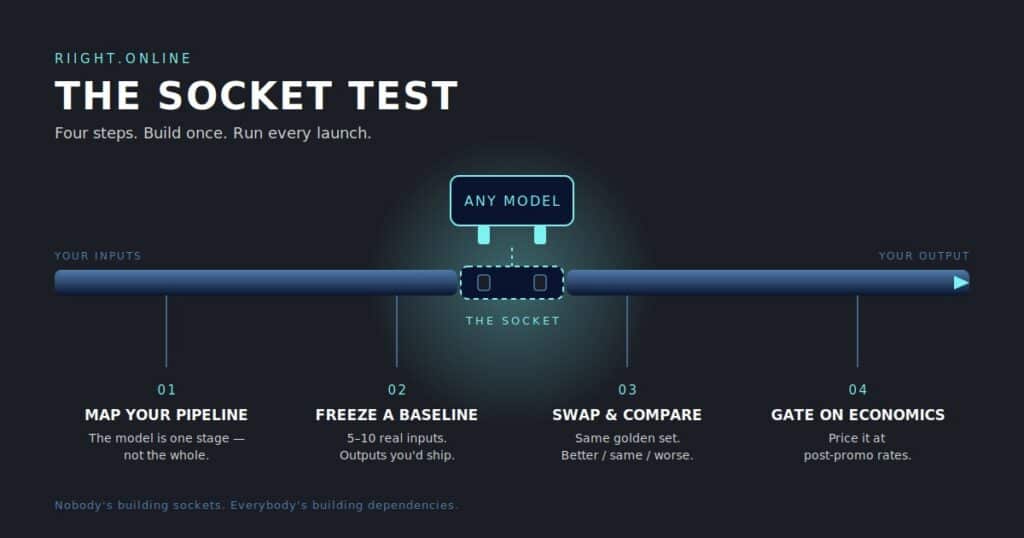
A socket is a fixed position in your pipeline where the model sits. The pipeline is yours — your inputs, your steps, your standard for what good actually looks like. The model is a part. A component you can pull and replace. When something new launches, you don’t read the reviews. You unplug the old one, drop the new one in, and run the same test you always run.
And if swapping the model breaks your output completely, you just learned something. Uncomfortable, but worth knowing: you never had a process. You had a dependency.
Building the socket takes four steps. Once. Let’s be honest about the cost: done firmly, it might take you a week’s work. But that’s a week you’ve already won back by using AI in the first place — you’re reinvesting a fraction of the time these tools save you into the one thing that tells you which tool deserves the job. After that, every launch announcement stops being your emergency and becomes someone else’s marketing.
Step 1 — Map your pipeline
Write down the stages of one thing you make regularly. Research → draft → review → publish. Brief → classify → route → report. Whatever yours is. Now mark where the model actually sits. In almost every pipeline I’ve looked at, the model is one stage — not the pipeline. If you can’t draw this, stop here. You don’t have a pipeline yet, and no launch is going to fix that for you.
Step 2 — Freeze a baseline
Take five to ten real inputs from your own work — not toy prompts, the actual messy ones — and save the outputs your current model gives you. The ones you’d genuinely ship. That’s your golden set. It’s the thing that defines what “good” means for you, specifically. Without it, every comparison is vibes. And vibes are exactly what the twelve-hour guides are selling you.
Step 3 — Swap and compare
New model lands? Drop it into the socket. Run the same golden set. Put the outputs side by side and judge them against your baseline — not against the launch blog. Three honest outcomes: better, same, worse. All three are useful. “Same” at a lower price is a win. “Better” on tasks you never do is irrelevant. Twenty minutes of this beats every PDF in your inbox.
Step 4 — Gate on economics
This is the step everyone skips. And right now it’s skipping them back.
Fable 5 is free on paid Claude plans through June 22. From June 23 it moves to usage credits: $10 per million input tokens, $50 per million output — double the price of Opus 4.8, which makes it the most expensive flagship on the market. Anthropic isn’t hiding any of this. They published it on day one and openly called the free window a sampling period, not a precedent.
So price the swap at the rates that apply after the window closes. Take your golden-set run, count the tokens, multiply. If the quality gain doesn’t cover a 2× cost jump for what you actually do, the answer is no — no matter how good the model feels in the moment.
And this is the bit I keep coming back to. People are wiring workflows onto Fable right now, during the free window, without having read the single most important sentence in the announcement. They’re hardwiring a part whose price tag they’ve never looked at into something they expect to run every day. On June 23 the meter starts. And the same crowd that wrote “Fable changes everything” will write “Fable is too expensive” — having read neither announcement properly.
That’s how much people don’t read. They just react.
The deadline is the sales mechanism
One more layer, because it explains the whole circus. The two-week free window isn’t generosity. It’s a sampling period with a deadline built into it. And the comment-gate crowd isn’t testing Fable — they’re reselling the urgency. Anthropic set the clock, the PDF hustlers monetize the panic around it, and the people in the comments pay with their attention and their contact details for an evaluation that nobody ran.
You step out of that whole loop with a socket. Not because models don’t matter — they matter enormously, this is the most capable software any of us has ever touched. But the only evaluation that counts is the one run on your work, against your baseline, at the real price. Everything else is someone else’s homework, and they didn’t do it.
So here’s the test. Next launch — and there’s one coming within weeks, there always is — don’t open the guides. Open your golden set. Swap, compare, price it. Twenty minutes.
If you can’t do that, the new model was never your problem. The missing socket is.
Fable 5 access and pricing: free on Pro, Max, Team, and seat-based Enterprise plans June 9–22, 2026; usage credits from June 23 at $10/M input and $50/M output tokens (Anthropic, June 2026).