
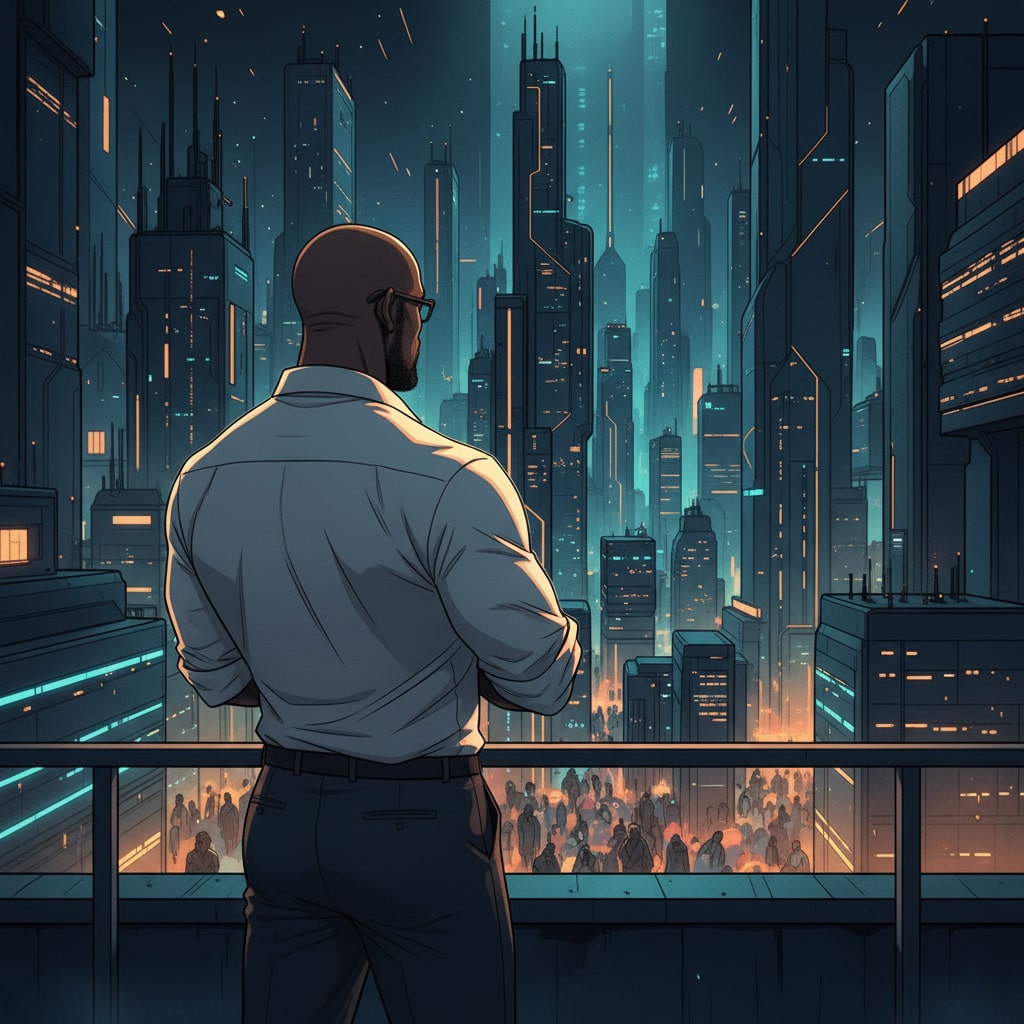

At street level, nothing looked broken. Websites still looked like websites. Traffic still looked like traffic. The lights were still on. The pages still loaded. If you glanced quickly, the web still felt familiar.
But the crowd had changed.
You only notice that kind of thing when you stop looking at the city as a map and start watching the door. Some visitors arrived quietly, checked the signs, and left. Some moved like they already knew the block. Some stepped inside for a second and vanished again. Some kept circling back. And some were clearly not there for the same reasons the old crowd used to be.
That was the part I could not unsee.
Around the same time,
one phrase started echoing everywhere: “AI visibility“
Everyone seemed to want it. Everyone seemed to talk about it. But the more I listened, the less convinced I became that most people meant the same thing when they said it.
Because from where I was standing, the way AI visibility was being measured felt far too thin.
Ask a prompt. See whether a brand shows up. Ask another prompt. Check again. Fire another one. Hope you hit something.
That did not feel like visibility to me. That felt more like shooting in the dark. Every shot was a prompt, launched without really knowing what happened before the answer appeared. Sometimes it worked. Sometimes it did not. But even when it worked, the bigger question stayed untouched.
How does AI see a site in the first place?
Not how a human browser sees it.
Not how a marketer wants to report it.
Not how a dashboard rounds it into a neat story.
How does AI actually encounter a website?
Can it reach it?
Can it read it?
Does it get blocked?
Does it render the page properly?
What does the site actually expose when the visitor is not a person, but a machine moving through the web in its own way?
That was the gap that started bothering me.
Yes, you could look at referral traffic. Yes, you could group parts of it in analytics. Yes, you could detect that something AI-related had probably touched your site. But that still did not tell me how those systems were arriving, what they were able to access, or what kind of version of the site they were actually dealing with.
And that difference matters.
Because being visible in AI does not start with being mentioned in a prompt. It starts much earlier than that. It starts with whether AI can access your site at all, what it finds when it gets there, and whether the surfaces it encounters are even remotely the same as the ones we assume are there.
That tension sharpened for me when I started testing more actively.
I ran prompts that triggered agent-like browsing behavior across the web. Not just answer generation, but active looking. Searching, comparing, moving from page to page. And what I saw was messy. Some sites blocked the agent outright. Some pages were only partially usable. Some renders felt incomplete. Some experiences looked nothing like the clean, full-page version a normal browser would suggest.
That triggered me.
Because once you see that, you cannot keep using the same lazy definition of visibility.
If AI sees your site differently, then availability inside AI cannot be judged by the same assumptions we use for a normal browser visit. And if our tools cannot show us what AI encountered, how it moved, or how much of the site it actually touched, then a lot of what gets called AI visibility is still built on fog.
That was the deeper irritation underneath all of this.
The buzz kept growing, but the understanding did not grow with it. The phrase had heat. It had FOMO. It had that strange cultural electricity where everyone reacts to the words before anyone has really pinned down the mechanics. That bothered me, because the market was rushing to score the outcome before it had learned to inspect the entrance.
So I did what I usually do when a system starts irritating me: I stopped admiring the problem from a distance and went to the door myself.
That is the cleanest way to explain what this project became.
My site stopped feeling like a static property and started feeling like a venue in a city with a new kind of nightlife. New visitors kept showing up. Some only checked the entrance. Some seemed to be mapping the building. Some looked around without really entering. Some behaved like ordinary passersby until you looked twice. I owned the place, but I still could not properly read the line outside.
So I became the owner and the bouncer.
That matters, because it sets the tone for everything that follows. This is not a detached software story. It is a field notebook from someone standing at the entrance of a place he built, trying to understand a crowd that no longer fits the old categories.
Not just who showed up.
But how they arrived.
What they touched.
What they were allowed to see.
And what the site actually looked like from their side of the door.
That is where this series begins.
Not with certainty.
Not with a finished theory.
But with a question I could no longer ignore:
If AI visibility is supposed to matter, then how does AI see us in the first place?
And if nobody can answer that properly, then I need to find out myself.